A summary: Schechner, R. (2002). Performance studies: An introduction. London: Routledge. pp. 123-128
Searle’s speech acts
1960’s, John R. Searle:
- “[S]peaking a language is engaging in a rule-governed form of behavior […] The unit of linguistic communication is […] rather the production or issuance of the symbol or word or sentence in the performance of the speech act.”
- speech acts are “behavior, as doings on at least three levels:
- the uttering of sounds formed into words and sentences
- words and sentences that refer to things and events or predict
- words and sentences that state question, command, promise, and so on.
- speech acts are to be studied within specific contexts (viewed as organized systems).
- people construct their realities largely by means of speech acts; and they communicate these realities to each other by means of speech acts
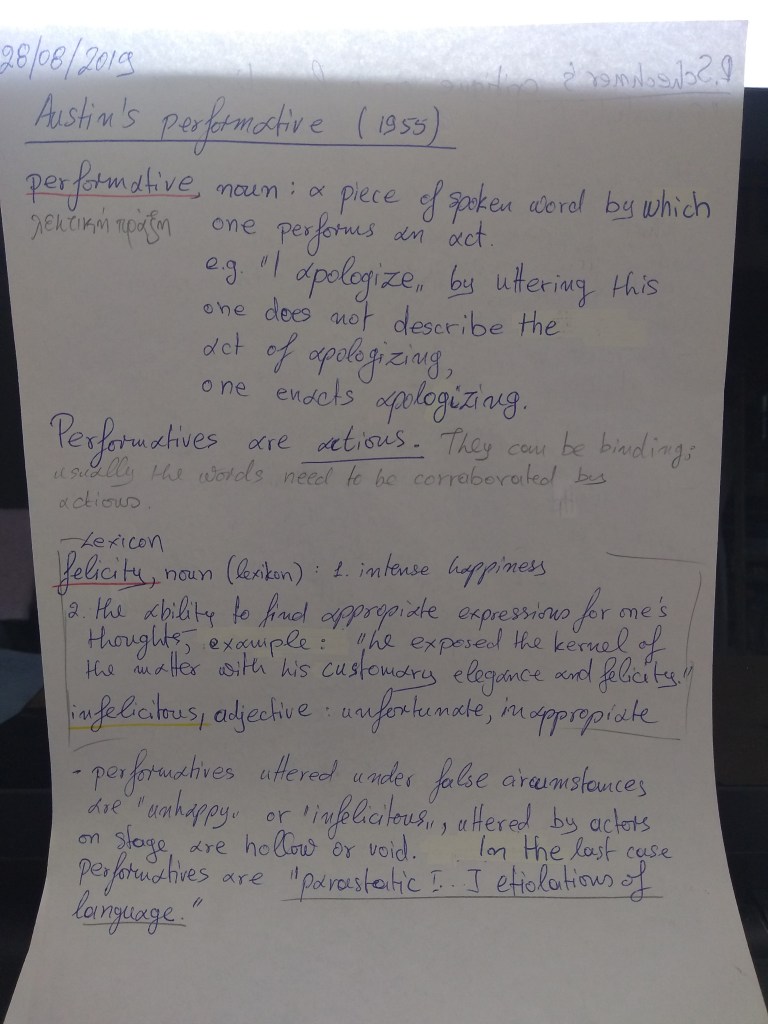
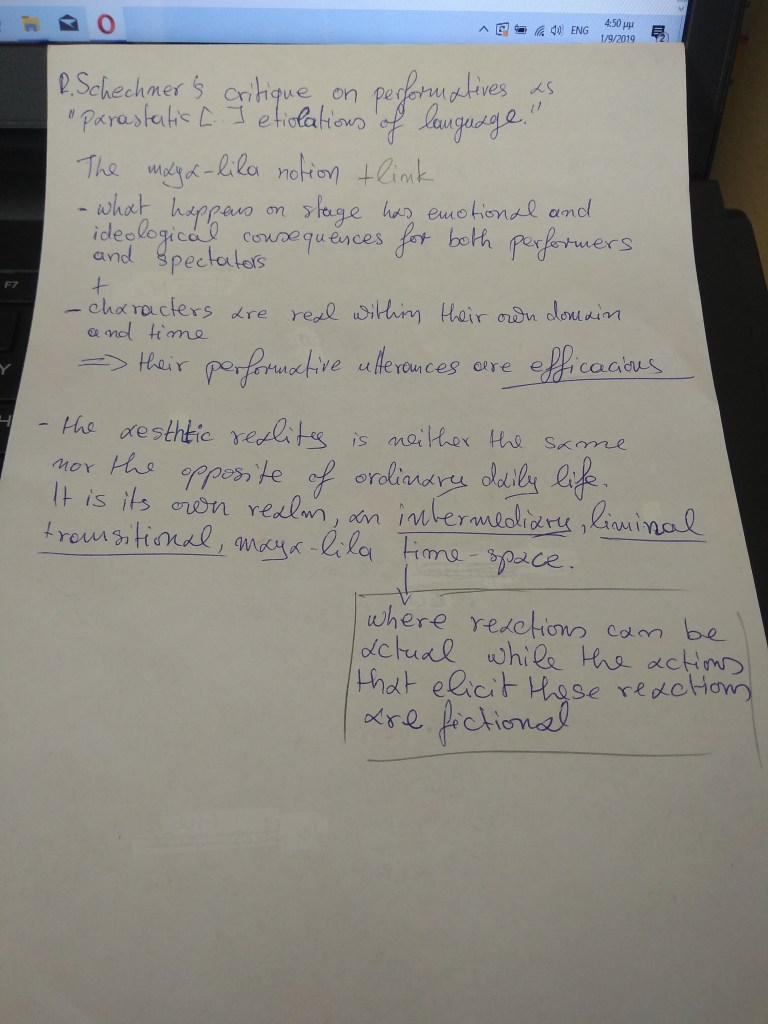
- there is a separation between “normal real world talk” and “parastatic forms of discourse such as fiction, play acting, etc.”
before 1960’s:
- distinctions between “fiction” and “reality” start to collapse
- this interplay of realities has increasingly become a central theme of performance art, film, Tv, internet, etc.
- the very idea of “original” has been sucessfully sabotaged
Reality TV and beyond
Example Survivor (reality TV-show that aired in May 2000)
- it’s based on dissolving the distinctions between the real and the staged
- what Survivor contestants are enacting is not improvised theatre, exactly; nor is it real life, exactly
- the combination of voyeurism and “that could be me!” is taken up by the thousands of webcam sites
Example JenniCam: in 1996 Jennifer Ringley decided to install a camera in her dorm room at Dickinson College in Pennsylvania bringing millions of viewers sometimes funny, sometimes intimate views of herself. Youtube – whose motto is “broadcast yourself” – is a hugely popular and profitable elaboration of the JenniCam idea.
Questions:
- Does the presence of cameras change behavior or converrt someone’s home from a “real-life” venue into a “theatre”? It is a sociological application of Heisenberg’s indeterminacy principle where the observation affects the outcome.
- Where will be the line separating private from public be drawn? Can it be drawn anywhere? The line is dissapearing, if it has not already vanished. These are situations addressed, but by no means resolved, by theories of performativity.
Postmodernism
Postmodernism means different things to the various groups of people that are related to it.
In the 1960’s the discourse about the postmodern made its appearance “with attacks on the “master-narratives” of modernism: the nation-state, natural law, rational logic, patriarchical authority, mandatory coherence, and beginning-middle-and-end stories. But after the deconstruction of the master narratives, then what? Fragmentation, pastiche, relativism, local tryths, delight in contradictions?”
“Recognizing, analyzing and theorizing the convergence and collapse of clearly demarcated realities, hierarchies and categories is in the heart of postmodernism.” In theatre a dissociation from traditional Western performance theory takes place. A theory within theatre “imitates”, “reflects”, “represents” or “expresses” individual actions and social life; within “art” and “life” are different orders of reality.”
Simulation
simulation in the lexicon:
- a model of a set of problems or events that can be used to teach someone how to do something, or the process of making such a model: The manager prepared a computer simulation of likely sales performance for the rest of the year.
- in football, the act of pretending to have been fouled to try to win a penalty or free kick unfairly: Young should have been booked for simulation, not awarded a penalty.
- the imitative representation of the functioning of one system or process by means of the functioning of anothera: computer simulation of an industrial process
- simulate: to give or assume the appearance or effect of often with the intent to deceive
Source: https://www.merriam-webster.com/dictionary/simulate, https://dictionary.cambridge.org/dictionary/english/simulation
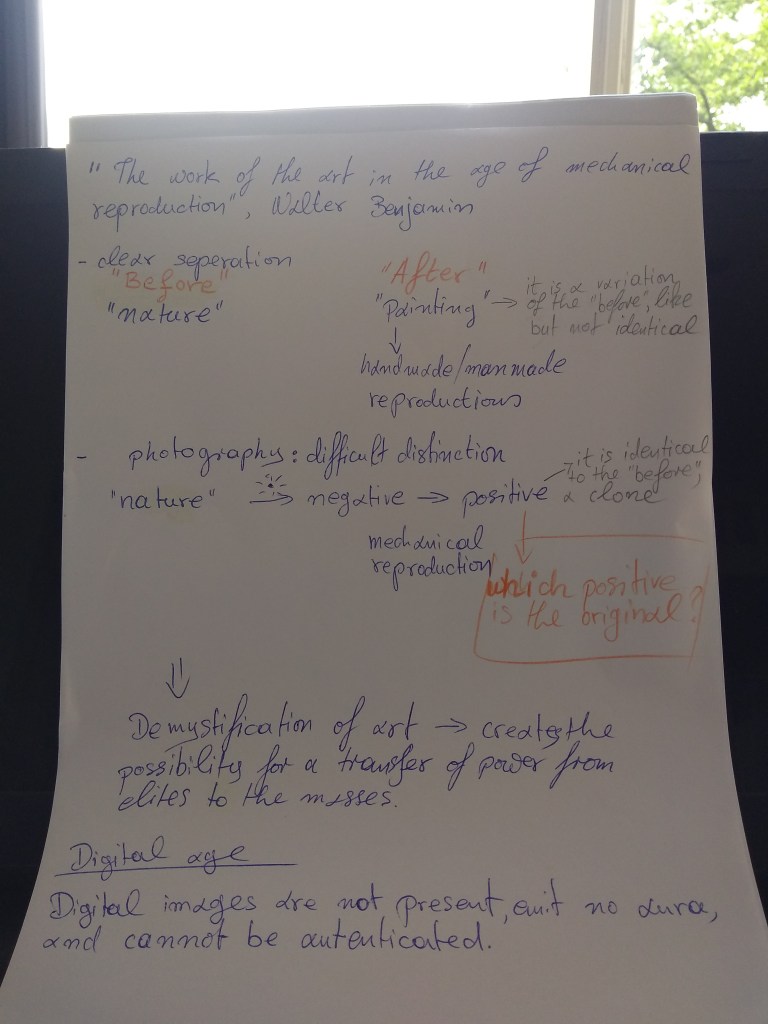
- with simulation representation ends and reproduction takes over
- digital copies are not “copies” but clones
- in popular culture simulation is closely related to “reality” TV and “real life” websites
- a simulation is neither a pretense nor an imitation. It is a replication of . . . itself as another
- that makes simulations perfect performatives
A convincing simulation is the presence of an appearance (where there is no original) or a replication so perfect it is indistinguishable from an original.
Example: Someone pretends to be sick, and by doing so hum produces symptoms of sickness. Thus the imaginary causes the actual.
The shaman – or any performer similary self-convinced – performs with such intensity and conviction that hum transcends the pretense that first characterizes hums performance. Hum pretends, then acts, then simulates, then arrives back at real life.
There are different kinds of simulation: elaborately designed entertainment environments (e.g. Disney parks), restored villages (e.g. Plimoth Plantation), scientific experiments, state armies simulating battles to exercise.
The rise of simulation is linked to technology developments, the permanent optimization of the performance of computers. ” The result is a conjunction of commercial, military, scientific, and academic operations where the ‘performance principle‘ is a concatenation of theatre, knowledge, and power.” Who controls these operations? Who produces knowledge? Who owns the produced knowledge?
Poststructuralism, a.k.a. deconstruction
Postmodernism and poststructuralism/deconstruction are best examined in relation to each other. Deconstruction is the academic response to postmodernism; the two combined constitute practices and theories of perormativity.
Poststucturalism, a discourse in cultural, linguistic and philosophical circles, emerges in 1960’s France as opposition to structuralism and in sympathy with the concurrent radical student movement. Nowadays “the ideas of poststructuralism and the techniques of performativity – simulation especially – have been eagerly taken up by business, science, and the military, eager to enhance their control over knowledge.”
Structuralism’s main agenda was to discover universal unconsious stuctures of language mind and culture. It made use of ” ‘binary oppositions’ to map the dialectical tensions of the system.”
Poststructuralists started off as anti-authoritarians. They discarded the notions of universal structures and binary oppositions, as these ideas led to over-simlified models and supported the status quo. They objected to the “notions of universals, originals, or firsts. To poststructuralists, every act, every utterance, every idea, is a performative:
- each phenomenon is regarded as part of an endless stream of repetitions, with no “first voice” of ultimate authority
- the flux of experience and history is the battleground or an ongoing power struggle
- unstable iteration replaces stable repreesentation
- postmodern repetition and recombination —- poststructuralist différance
Derrida’s “writing”
- “writing”: all-inclusive field of cultural expressions and social practices; systems of “inscribed” power (laws, rituals, traditions, hierarchies, politics, economic relations, science, the military, and the arts)
- “text”: all human culture as constructed sets of relations
- inscribed power performs its privileges by means of established authorities (> author)
- who writes performs authority
- all authority is temporary; no “writing” is either first or final
- behind every writing are other writings
- every writing is a power struggle
- history is not a story of “what happened” but an ongoing struggle to “write” historical narratives
- every narrative is full of “aporias” (holes) which leak various pasts and alternatives into the present order of things
- the ineluctable continuity – a knowable past that determines a stable present leading to an inevitable future – is a fiction.
Derrida’s différance
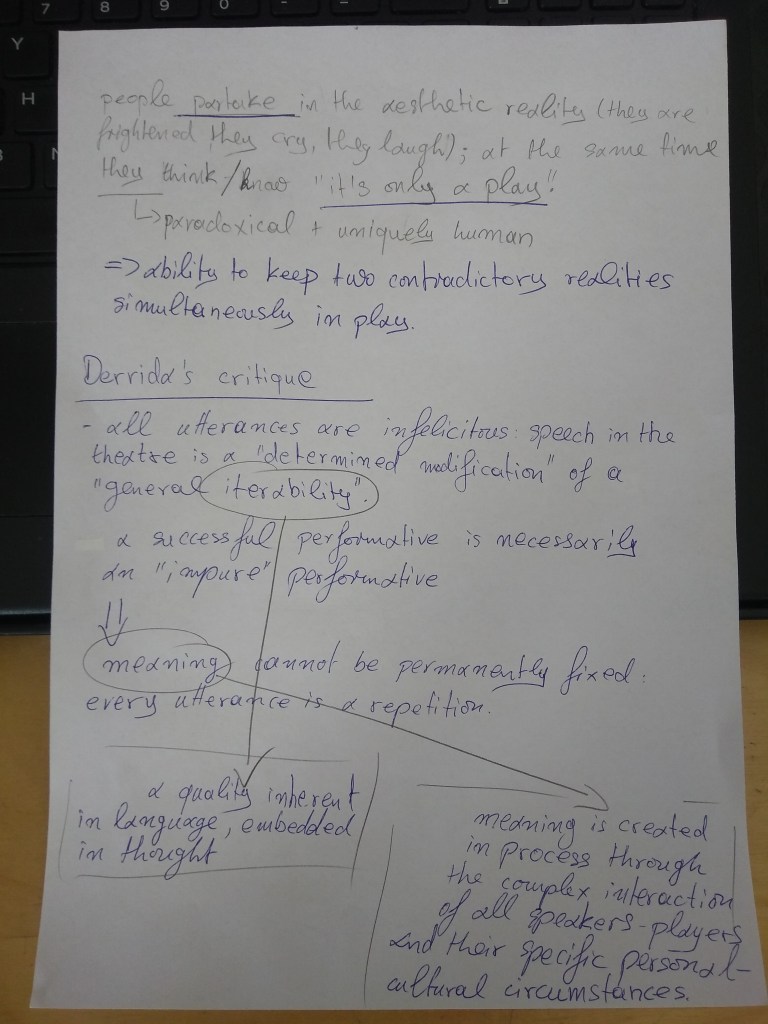
- différance: “difference” + “diferral”, otherness plus a lack of fixed or decided meaning
- writing is a contested system of erasing and composing, thus meaning cannot “be” once and for all, meaning is always performed, its finality forever diferred
- language in general and speech acts in particular depend on an active estrangement, an encounter with “otherness”, on doing and showing at the same time
Constractions of race
Are there any dependable markers of race?
- biologist and anthropologist agree that race has no basis in genetics or biology
- DNA examination shows that there is “a virtual continuum of genetic variation” around the world (Kenneth Kidd of Yale University)
- “there aren’t any boundaries between races” (John Moore of the University of Florida)
- race is like ethnicity, a human cultural feature/ cultural construct, thus its identifications change in reaction to cultural-specific historical forces
- still racial categories and stereotypes reffering to loos and behavior are used widely, oten classiying “the Other” as inferior
 performance practices_divergent temporalities