“people as never before live by means of performance”: a case of interlinked spheres
A summary: Schechner, R. (2002). Performance studies: An introduction. London: Routledge. pp. 28-51.
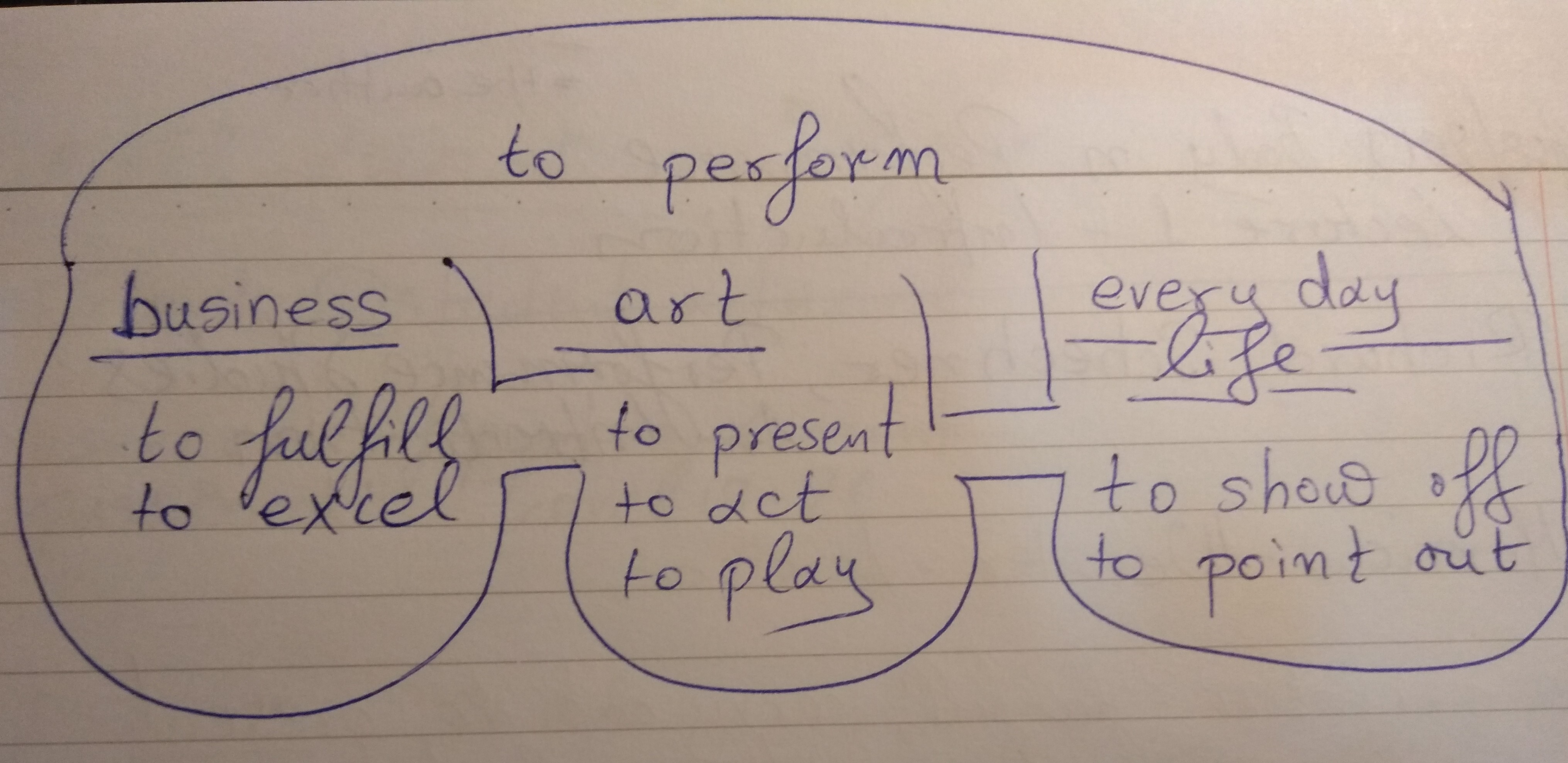
What is “to perform”?
a) Being: existence, philosophical category
b) Doing: actions, always changing
c) Showing doing: actions, always changing
d) Explaining “showing doing”: trying to understand the world of performance and the world as performance
Performances of art, rituals and every day life
Performances are “restored behaviors”/ “twice-behaved behaviors”, actions that do not occur for the first time; people have trained/prepared – intentionally or not – to carry out these actions.
Dancers train to be able to perform, but we also train in every day life: a child learns and rehearses specific behaviors to become an adult, activities of public life such as a demonstration are collective performances. Every action of human life is a restored behavior and can be studied “as” performance.
In everyday life actions can be “restored behaviors” and at the same time “one-time events”, which is a paradox. “Everydayness” is familiarity: every day life consists of prepared/familiar parts of behavior that are put together according to specific situations. “Onceness”: i) the countless combinations of these familiar parts ii) the unique context, iii) the reception and interactivity make up the “onceness” of the event.
The “between” nature of Performance
A performance takes place as i) action: what does an object/piece of performance do? ii) interaction: how does it interact with other objects or beings? iii)relation: what is its relation/relationship to other objects/beings?
Performance encompasses a broad spectrum of possibilities
An indicative list. Performances take place in eight situations, which can be separate or overlapping; some situations can appear as umbrella terms or as a qualitative component of other situations:
- in everyday life
- in the arts
- in sports and other popular entertainments
- in business
- in technology
- in sex
- in ritual – sacred or secular
- in play
Performance and art are not the same thing
What is art? What is “good” art? The answers to these questions vary depending on historical period, place, culture and use.
In many cases it is difficult to distinguish between the kinds of performance listed above: art and ritual, art and sports, performance in business and sexuality melt together. For example gospel music is part of a mass in church and also a music genre, figure skating is obviously an artistic sport but even a football player’s intricate move could be artful and aesthetically pleasing. Still we can tell the difference between all these events, because of i) their function, ii) their circumstance within society, iii) the venue, iv) the behavior expected of the players and spectators.
Some features of restored behavior
- The bits of behavior can be rearranged or restructured.
- “They have a life of their own”: they are independent of the systems that generated them, their source and way of creation can be unknown, “the units of behavior that comprise ‘me’ were not invented by ‘me’ “.
- They can be of long or short duration (a religious ritual, waving goodbye).
- They are the key process of performing.
- Restored behavior in rituals, games and everyday life are created by the collective “Anonymous”.
“Living life” and Performance
Any action can be restored behavior. “Living life” is restored behavior. “Performances are marked, framed or heightened behavior separated out from ‘just living'”. Henceforth, this marked, framed or heightened behavior is referred to as restored behavior.
If any performance is already behaved behavior, what about originality? Most of the times originality is ” a new combination of known behavior or a the displacement of a behavior from a known to an unexpected context or occasion”.
Restored behavior is symbolic: you need to know the code in order to understand it. It is also reflexive: “to become conscious of restored behavior is to recognize the process by which social processes in all their multiple forms are transformed into theatre in its broader sense”.
Paradox reminder: Each performance as enacted practice is specific and unique (personal choices of participants, time and space, conventions and traditions of a genre or a sub-genre, cultural patterns, reception, audience, interactivity).
“Is” and “as” Performance
The “is”
The definition of what “is” a performance depends on a specific coincidence ( = time + space + culture + usage + humans…).
The example of theatre in Europe demonstrates how each “coincidence” defines in its own way what a term means.
Ancient greek theatre: in 5th century B.C. tragedies were staged, the occasions were religious festivals, one of the goals was to compete and win a prize. In 4th century B.C. Aristotle codified ancient greek drama.
Medieval theatre: in 14th century the great cycle plays related to the Catholic Church and the multitude of preexisting popular entertainment appeared in medieval Europe. The Church wouldn’t call this theatre, but we do nowadays.
Theatre in 20th century – today: avant-gard counter-movements aim at breaching the established idea of theatre.
In the 1970’s the term “performance art” appears to encompass art works that wouldn’t fit in any other category. “The tendency has been to dissolve the boundaries separating performing from not-performing, art from not-art.”
The “as”
Amongst many things “to perform” means to do something according to a specific plan or with certain goals in mind. Example:
Gerardus Mercator was a Flemish geographer-cartographer who created a system of map-making suitable for navigation and for the commerce of colonial powers of the 16th century Europe. The different parts of the globe are disproportionate on his flat map. The depiction of the northern hemisphere is greatly enlarged compared to its real size.
1974 Arno Peters created a map that displays the correct size of the different parts of the globe. For this he had to sacrifice their accurate shape.
Each map-making system portrays the Earth in a specific way (which enacts the system’s own rationale) and it reifies particular power relationships.
To study something “as” is to examine it “from the perspective of” a specific field of study. That means that the same object or piece of work can be regarded from different perspectives depending on the interest of the inspector.
Make-belief and make-believe
Performances can be
i) make-believe actions: in these cases the world of the performance and the everyday reality are clearly separated by means of conventions and codes. An actress is playing a role on stage. She herself and the audience know that the actress is a real human being whereas the character she is embodying is made up for the purpose of a theatrical play and does not exist in reality.
ii) make-belief actions: the boundaries between the world of performance and the everyday reality are intentionally blurred. A public figure stages carefully his appearance so that his image and intentions are received by the audience as an already existing reality.
Blurry boundaries
The above mentioned categorization is a clear one. In the first case the boundaries are fixed, in the second case the boundaries are blurry.
published by Veritasium.
In 1927 Werner Heisenberg, a German physicist, introduced his “uncertainty principal” to the scientific world. Since than “uncertainty” has affected various fields of study.
Fixed national borders, fixed art genres are dissolving, ideas of networks of information, of relationships, of commerce, globalization, intercultural fusion are expanding around the world.
The functions of performance
Schechner suggests seven functions of performance:
- to entertain
- to create beauty
- to mark or change identity
- to make or foster community
- to heal
- to teach or persuade
- to deal with the sacred and the demonic.
This list is best depicted as a scheme of interlocking spheres. The number of functions and their hierarchy in a performance depends on who wants to get what done.
Continuum
In order to combine the broad spectrum of “as performance” and the defined boundaries of “what is performance” Schechner suggests a continuum, where performance genres, performative behavior and performance activities are blending into one another and interacting.
a) PLAY-GAMES-SPORTS-POP ENTERTAINMENTS-PERFORMING ARTS-DAILY LIFE-RITUAL
b) GAMES-SPORTS-POP ENTERTAINMENTS-PERFORMING ARTS-DAILY LIFE-IDENTITY CONSTRUCTION PLAY AND RITUAL
Again these straight lines are best depicted as a 3D network of interconnected spheres. In a) play and ritual are at opposite ends, in b) we can see that they are linked to each other and they are displayed as pillars of the continuum.
 performance practices_divergent temporalities